The 4th amendment famously protects Americans from unreasonable searches and seizures, meaning that ICE cannot enter your home without a valid judicial warrant or your explicit consent. However, ICE’s widespread use of administrative warrants, signed not by a judge but by an immigration officer, can cause confusion among tenants unfamiliar with the difference.
Below is an example of a judicial versus and administrative warrant:
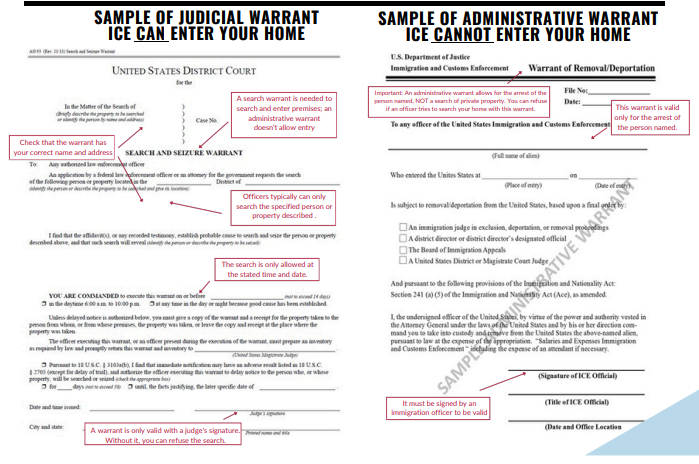
*Example of a judicial vs. administrative warrant, from Know Your Rights, 40th Ward of Chicago (2025). (https://40thward.org/2025/01/know-your-rights/).
Recent internal ICE memos have claimed that they can use an administrative warrant to enter a home for the purpose of conducting a final order of removal. The legality of this assertion is questionable, and unfortunately the power you have in the moment to remind ICE of their constitutional limitations while they are at your doorstep is limited. For that reason, we suggest Isla Vista tenants take the following steps in the case that an ICE agent knocks on their door:
- Do not open your door. This may be interpreted as an invitation inside and an unnecessary risk.
- Clearly state that you do not consent to ICE entering your home and that you are exercising your 4th amendment rights under the U.S. constitution. Ask for them to slide their warrant under your door so that you can inspect it.
- If it is an administrative warrant, clearly state that this does not grant them entry into your home.
- Remain silent. You do not have to speak to ICE officers nor answer their questions. You may state that you are exercising your 5th amendment right to stay silent and that you do not want to speak to them.
Taking all the right steps in the moment can be daunting. Because of this, we highly suggest that if you anticipate or are concerned about facing an ICE officer, you should prepare now. Plan with the help of an immigration attorney on whether you should make statements, whether you should provide documents, and more ahead of time.
The UC Immigrant Legal Resources Center provides legal resources to undocumented, immigrant, and mixed status students and their immediate family members. We urge you to use this resource if you cannot afford an immigration attorney. They can be reached at: ucimm@law.ucdavis.edu, (530) 752-7996, or https://ucimm.law.ucdavis.edu/